World of Level Design™
Tutorials to Becoming the Best Level Designer and Game Environment Artist (since 2008)
Why I Failed for Years at Level Design and Game Environments
Category: Environment Art, Level Design
November 29, 2011 (Updated: November 17, 2016)

Looking back over last decade it is easy for me to say what I did wrong, what I should have avoided, what I could have done better and where I should have focused my time on in learning level design and game environments.
The mistakes and failures I went through were extremely valuable, even though at the time it seemed like I wasn't going to pull through.
But, I do wish someone could have told me a few things to make level design and game environment art creation a simpler process to go through. Certain principles to keep in mind and goals to aim for so I didn't have to re-invent the wheel. It would have helped me to avoid starting a project after project and never finishing a single one.
The biggest roadblock I had to focus on was planning. I needed to know what I was going to create before starting any projects. I believed that if I had the foundation, vision and a plan to execute it would help me finish my work.
The 4 Categories
Level design and game environment creation can be broken down into 4 categories:
1. Planning or Preproduction: a plan, vision of an idea to go after that is concrete and worthwhile to pursue.

2. Gameplay: includes pacing, flow, balance, objectives, obstacles, set pieces/scripting and player progression/experience.

3. Visuals/Artistic: color, lighting, style, textures, materials, aesthetics; the visuals of the environment (graphics).

4. Technical: knowledge of the software and technical game art foundation - 3d modeling, UVing, texturing, level editor tools.

Before you can work on gameplay, visuals and technical aspects of your game environment, you have to plan everything out.
The Process That Didn't Work
This is how I used to design game environments and level designs.
- I had an idea
- Go straight to the level editor and begin creating
All I had was an idea and I would begin constructing. No wonder I didn't finish many projects.
There was no planning involved. I didn't research or do extensive collection of image reference, I didn't explore various layouts, I didn't create environment story, and I didn't set up a visual theme or make any production lists.
For a few hours it was fun. Idea would begin to take shape inside the level editor. I would be excited. Then, very slowly the entire map would begin to collapse. When I encountered my first problem or a decision I had to make, I didn't know what to do.
More and more questions began to pop up during production. I did not have answers for them because I had no foundation to rely on. I would begin to make decisions on the fly. I would get more ideas and try to incorporate them into the current environment. As the environment began to grow in scale and complexity, I became overwhelmed. I would try to change the layout and the original idea in middle of production - which often destroyed the project.
Soon after, the entire environment would fall apart. I'd get frustrated, discouraged and move on - I would abandon the map.
I would then begin a new idea, new project. Thinking this time it will be different. This time I will push through and finish.
Of course nothing different happened, because I didn't change my process - this continued for a few years.
Example of a map I attempted to work on back in the day. No plan and poor execution. I became frustrated with the map and never finished it. I had no vision what I wanted the environment to look and play. I ended up changing textures, layout and gameplay throughout entire production.

I often would get so pissed off at myself that every map and every game environment project I started did not get finished. It came to a point where I stopped creating maps for a while. I gave up.
The Time I Gave Up
I was fed up. I reached a point where I walked away from level design and game environments. I told myself that I would pursue other things; that level designing and game environment art wasn't for me.
So for next few years I went to multiple colleges studying filmmaking, drawing, painting, architecture, programming, web design, photography, business and management. I ended up getting a B.F.A in Computer Animation.
The thing was, my love for level design and game environments never left. Throughout my entire college career I wanted to design game environments. I would always get more ideas that I would want to create. Environments I wanted to see come to life. I was obsessed about level design and game environments. I just suppressed it and pushed it away.
During my junior year in college studying Computer Animation, everything began to click. For senior thesis I had to create a 2-minute animation short. But before anything could be modeled, textured or animated, I had to spend an entire semester during junior year in prepro. This is where I had to create a story, design characters, props, visual style and environments without every opening up a 3d application - all on paper.

I would have to present the story and all the design ideas to faculty for feedback. This continued for an entire semester. No modeling, no lighting, no animation - just preproduction for a 2-minute story. One full semester!
If this is what I had to do for a 2 minute short, I need to do the same for my level designs and game environments. Perhaps not a full semester but enough of sufficient time had to be dedicated to planning before opening a level editor.
The Trip That Changed Everything
In summer, right after my junior year I took a trip to Switzerland, before I had to return to work on my senior animation thesis.

Something happened during the trip that made me realize level design and game environments was something I had to do. I couldn't ignore it anymore.
I never wanted to animate. I thought I did when I first got into college to learn computer animation. But more I animated, the less I ever wanted to animate anything ever again. Going through computer animation program made me realize how much I love level designs and game environments.
Sometimes you have to do the thing you hate to make you realize what you love. This is what happened to me.
I came back from Switzerland with a month left of summer vacation. During that time I started and finished a playable map in 3 weeks. For me this was huge revelation. I never started and finished anything that quick - ever.
In those 3 weeks, I spend first few days planning. Just like I did in prepro class for my animation thesis.
3 weeks later, I had a playable map, DM-IceyApex.

Next big breakthrough was 11-day level design where I created a map in 11 days. You probably already read "How I Created a Map in 11 Days" ebook.

I Developed a Planning Process
I began to develop a planning workflow. This gave me a sense of purpose and clear goal to aim for when I would begin creating game environments.
Planning out level designs and game environments helped me to know exactly what I wanted to create before I opened a level editor or 3d application. I now had a foundation to work with, something to rely on when I encountered problems during production.
Planning gave me the confidence to pursue the idea.
Now, planning did not make me finish all of my maps and it will not make you finish everything you start. But I realized that planning is a very important part of a larger process.
I believe that a proper plan; a strategy for a game environment or a level design is the foundation of a good map. It is the blueprint that everything else can be built on. It is like a house foundation, if it's faulty eventually the structure will collapse. Game environments that are planned out have a higher chance of seeing the light of day than a vague idea where you jump into the editor without ever spending time in preproduction.
No successful game studio ever creates a game or any level/game environment for it without spending time in preproduction.
The above settings are a good start. The rest should be enabled on the "need to use" basis and as you become more proficient with modeling in Maya LT/Maya.
Preproduction Blueprint
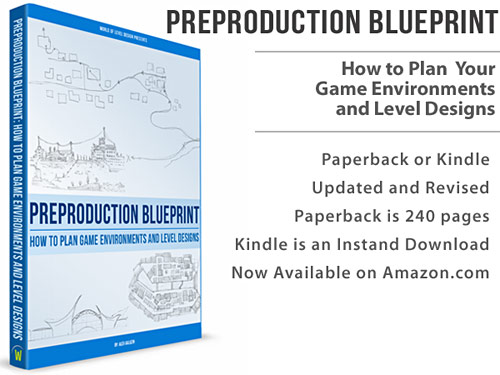
The planning workflow is called preproduction. It has taken me years to figure it out and to put it in a step-by-step process. Best part is you do not have to fail over and over like I did. I put the entire workflow into a book called "Preproduction Blueprint: How to Plan Game Environments and Level Designs" for you to learn from.
The book includes:
- Updated and revised
- 240 pages and 11-step planning system workflow
- Two versions are available: Paperback or Kindle
- Paperback version qualifies for free shipping (US Only)
- Kindle version is instant digital download
- Purchase and check out with Amazon.com
- Preproduction Blueprint is not game or engine dependent. It is a stand-alone planning system that can be used for any level design and game environment project.
Full "Preproduction Blueprint" is available as paperback or Kindle here on Amazon...

SUBSCRIBE & GET 2 FREE PDF GUIDES
Subscribe to WoLD and receive 2 FREE PDF Level Design Guides (200+ pages).
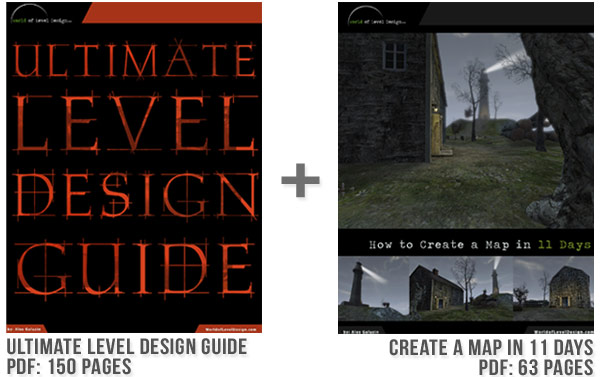
Want to know more what you are getting by subscribing?
TOP 7 TUTORIAL COURSES FOR 2026
 Modular Environment Design Masterclass Tutorial Course
 Maya Foundation: Home-Study Course - Model and UV Environments
 Substance 3D Painter Essentials - Master Texturing
 UE5: Fundamentals Vol.1 - Create with Unreal Engine 5
 UE5: Retro Office Project - Create Beautiful Interior Env
 UE5: Master Material Creation - Create Master Materials in UE5
 Preproduction Blueprint: Plan Environments and Level Designs
TUTORIAL CATEGORIES
MODULAR ENVIRONMENTS MASTERCLASS

LEARN THE PREPRODUCTION PROCESS
ABOUT WoLD & ALEXG

My name is AlexG. I am self-taught level designer, game environment artist and the creator of World of Level Design.com. I've learned everything I know from personal experimentation and decades of being around various online communities of fellow environment artist and level designers. On World of Level Design you will find tutorials to make you become the best level designer and game environment artist.
Home Terms of Use/Trademarks/Disclaimers Privacy Policy Donate About Contact
All content on this website is copyrighted ©2008-2024 World of Level Design LLC. All rights reserved.
Duplication and distribution is illegal and strictly prohibited.
World of Level Design LLC is an independent company. World of Level Design website, its tutorials and products are not endorsed, sponsored or approved by any mentioned companies on this website in any way. All content is based on my own personal experimentation, experience and opinion. World of Level Design™ and 11 Day Level Design™ are trademarks of AlexG.
Template powered by w3.css